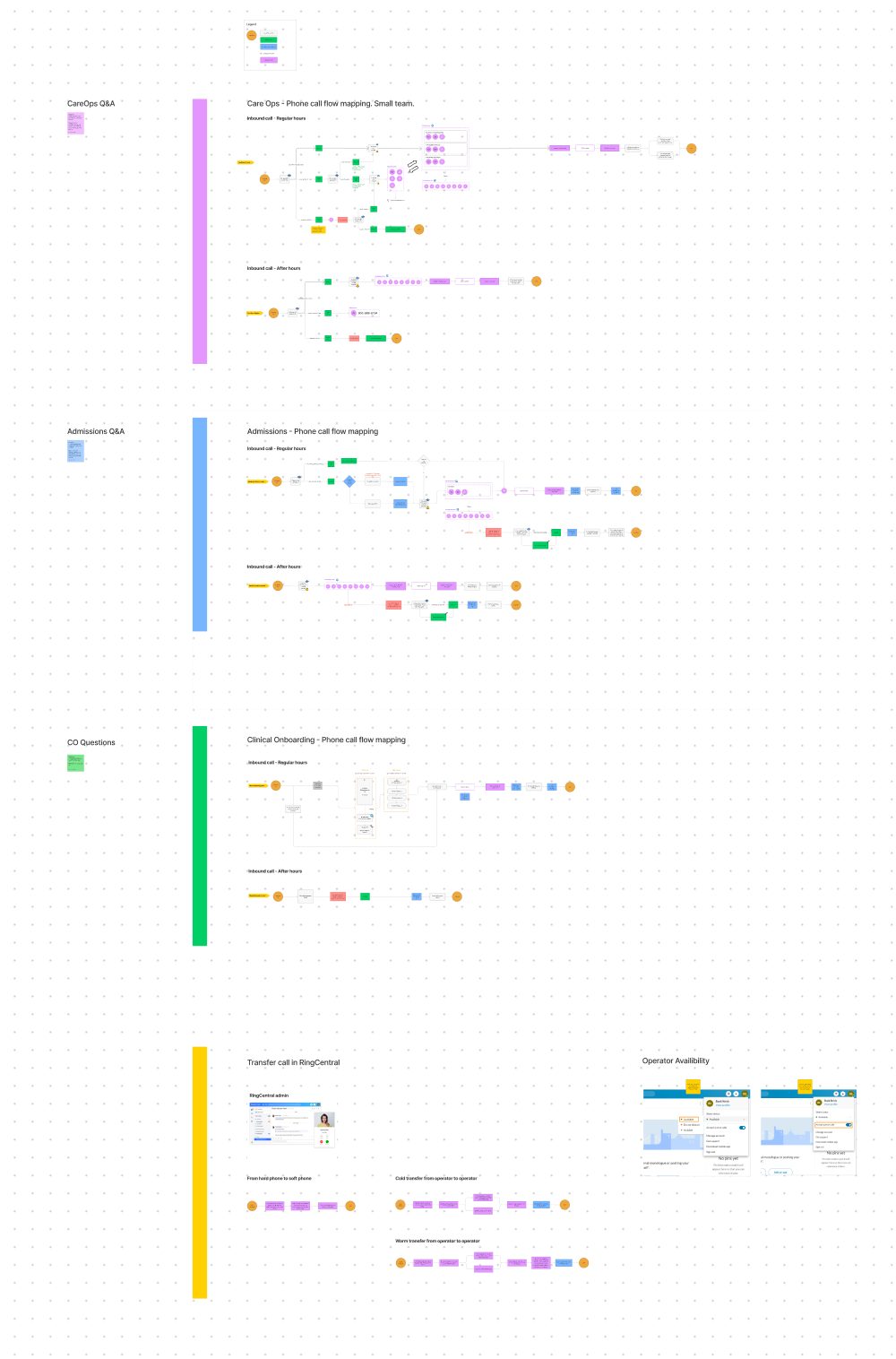
Rethinking the current phone system mapping in healthcare service
- Company
- Cold Start
- Domain
- Healthcare
- Discipline
- Service design
Context
Company: Empower Care.
Empower Care provides a range of hospice and after-life services.
With the scaling of the admissions and clinician team and the number of calls, there was a request to re-design the phone call mapping and how it should work to provide the best patient experience possible.
Problem
Phone system work based on legacy software without integration with Salesforce.
- Transfer to new software - Ringcentral. This service has much more capabilities than the previous service. The question is which one we need and which can technically be used.
- There are three separate numbers without centralized hotline numbers. That leads to constant manual re-routing calls between departments.
- An increasing number of calls are left unanswered. The team has to recall when they are free.
- No virtual reception, single operator who re-routes calls that are not specified (e.g. salesman asking about medical supplies refill).
- No clear understanding of how the phone system should work during non-working hours.
Solution
Phase 1. Discovery
01 Stakeholder’s interviews
We have to understand the current pains and needs of people who are on phone the whole day.
I started conducting personal interviews with representatives of the Admission, Care Operations, and Clinical Onboarding teams. Due to legal and ethical reasons patient interviews were not possible to do.
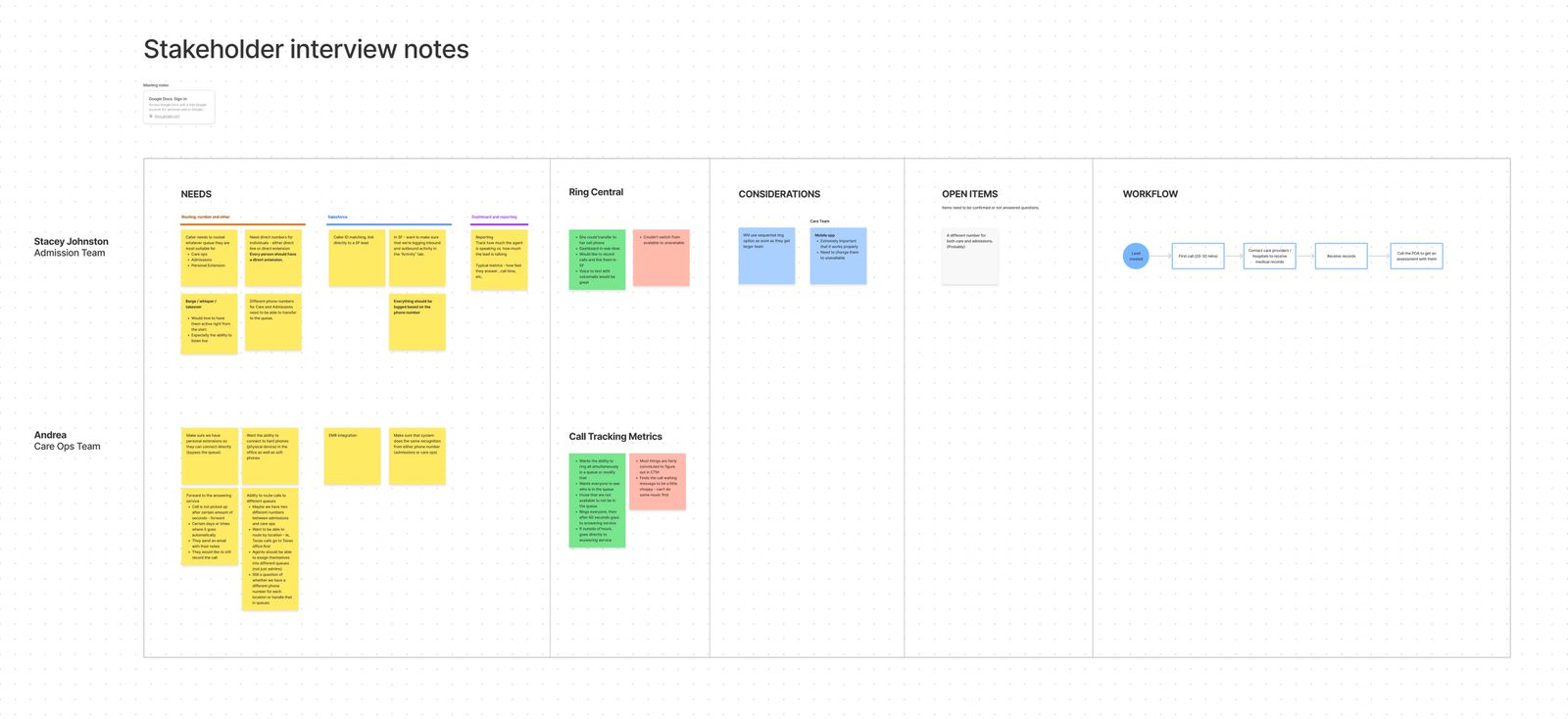
After the interviews, I gathered all findings: pain points, needs, the experience of using phone software in past, considerations of how it can work best, and other notes.
02 Features prioritiziation workshop
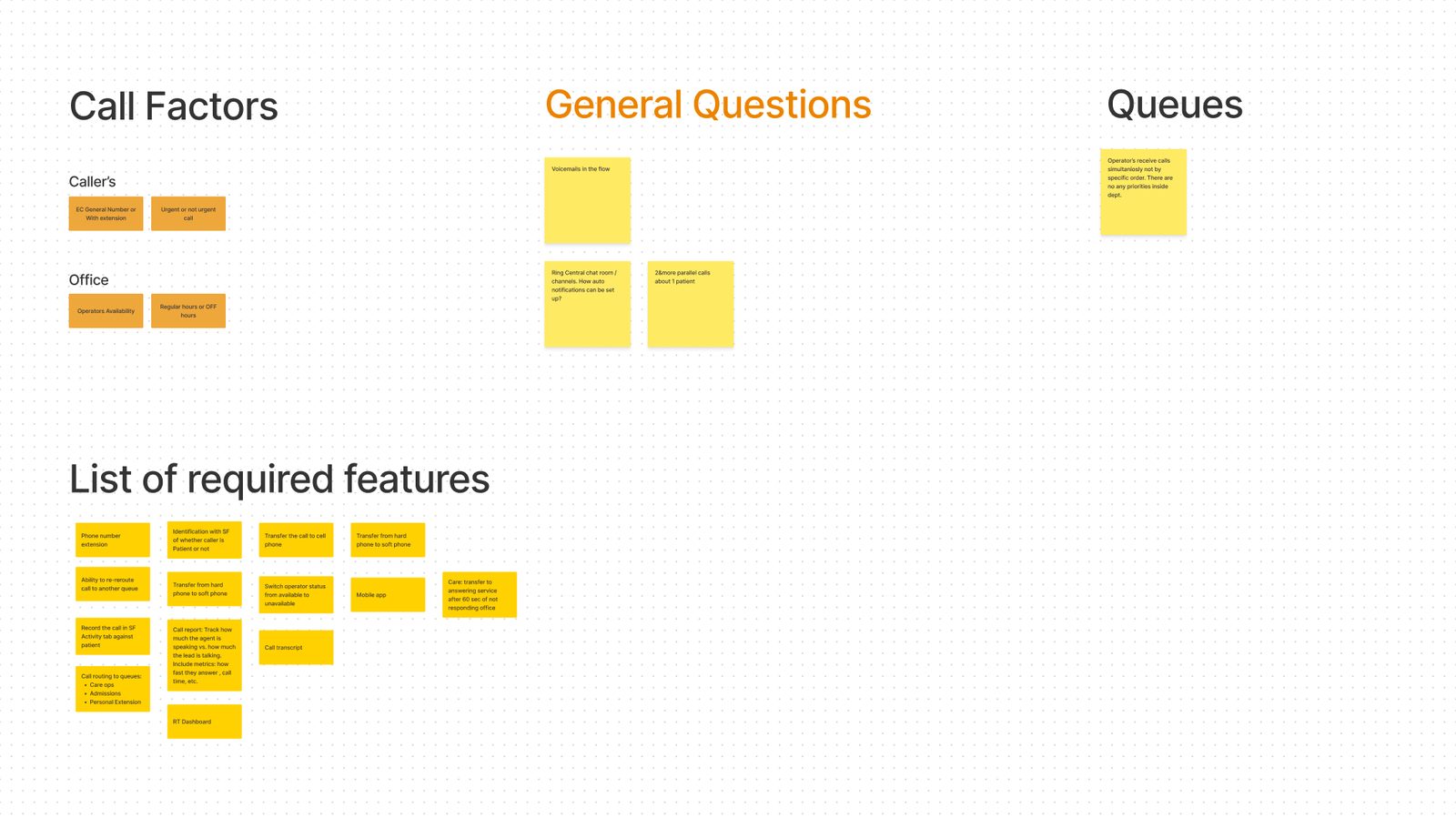
Based on the interviews I created a list of required features, questions left unanswered and technical considerations.
For each feature, I verified the technical feasibility.
Phase 2. Design
Good services are: Good for the user of the service. It does what they need it to do, in a way that works for them. Good for the organization providing it. It’s profitable and easy to run. Good Services: How to Design Services that Work Lou Downe
I created a phone mapping flow considering multiple factors:
- Working/non-working hours
- Operators queues
- New/existing patients
- Calls and operators’ prioritization
I documented flows for:
- Admissions team
- Clinical onboarding team
- Care Operations team
Also was created a separate flow for transferring a call.
To solve current problems we introduced the following:
- Automatic branching depends on if the patient is new or existing
- IVR to decrease workload for operators
- ‘Please wait song’ while connecting patient with operators.
- Rules of call prioritization were introduced.
- Calls are recorded and automatically attached to the EMR patient profile.
- Documented workflows in the case no operators are available.
and more solutions.